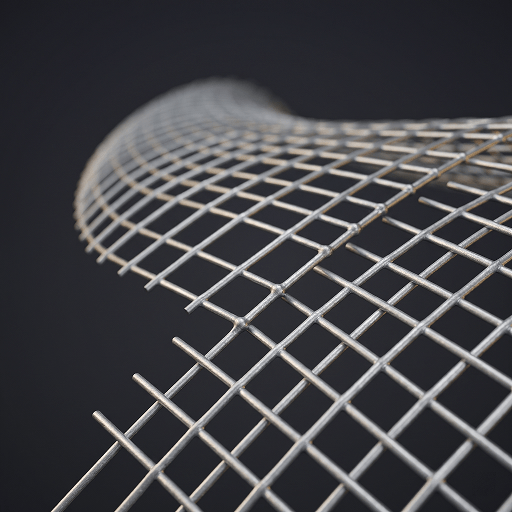
GI welded wire mesh is a steel wire grid with intersecting wires joined at their crossing points and a galvanized surface. Its suitability depends on the mesh dimensions, wire gauge, coating and intended application.
A Galvanized Finish with Welded Construction
What Is GI Welded Wire Mesh?
GI welded wire mesh is a metal grid made from intersecting steel wires joined at their crossing points and supplied with a galvanized surface. The welded construction creates a regular pattern of openings, while galvanizing provides a zinc-based protective coating intended to help reduce corrosion of the underlying steel.
The performance of the finished mesh depends on its wire gauge, aperture, material, galvanized coating and operating environment. Galvanizing can provide useful protection, but the level of protection depends on the coating characteristics and exposure conditions. It should not be treated as a guarantee against corrosion in every environment.
GI welded wire mesh can be considered for suitable fabrication projects, partitions, screening panels, enclosures and other applications requiring a regular metal grid. Its suitability for any particular structural, safety-related or load-bearing use must be assessed against the relevant project requirements.
Accurate Wire Mesh lists GI welded wire mesh with a 1/2 × 1/2 inch aperture, 14 and 16 gauge options, a 50 ft length, and widths ranging from 2 ft to 6 ft in specified increments. Buyers should confirm the required combination and current availability before placing an order.
Review Sizes and Options
GI Welded Wire Mesh Specifications
| Wire Gauge Options | 14 gauge and 16 gauge |
|---|---|
| Length | 50 ft |
| Available Widths | 2 ft, 2.5 ft, 3 ft, 4 ft, 5 ft and 6 ft |
| Mesh Aperture | 1/2 × 1/2 inch |
| Wire Material | Steel wire; confirm the precise material specification |
| Surface Treatment | Galvanized |
| Wire Diameter in Millimetres | Confirm the conversion and exact wire specification |
| Custom Dimensions | Subject to confirmation and availability |
Mesh for Suitable Fabrication and Screening Projects
Where Can GI Welded Wire Mesh Be Used?
| Fabrication Projects | Used in custom components requiring a regular grid. |
|---|---|
| Partitions and Dividers | Suitable for framed metal partitions and dividers. |
| General Screening | Supports screening where 1/2 × 1/2 inch openings are suitable. |
| Protective Enclosures | Used in suitable enclosures with compatible frames and fixings. |
| Storage and Organisation | Suitable for selected racks, dividers, and storage components. |
| General Industrial Use | Used for industrial screening, separation, and fabrication. |
Match the Listed Options to Your Requirements
A Practical Guide to Choosing GI Welded Wire Mesh
Choosing Between 14 and 16 Gauge
The catalogue lists both 14 and 16 gauge options. Before deciding between them, confirm the corresponding wire diameter and discuss the application’s requirements with the supplier.
Do not select a gauge solely on the assumption that a particular option will satisfy a load, impact or safety requirement. If the mesh is being used in a technical assembly, the full design must be assessed against the applicable specifications.
Selecting the Width and Length
The listed widths are 2 ft, 2.5 ft, 3 ft, 4 ft, 5 ft and 6 ft, with a listed length of 50 ft. Check the dimensions of the installation and account for cutting, overlap, framing and edge finishing where applicable.
Confirm whether the required width and gauge combination is available and how the product will be supplied before finalising the material quantity.
Assessing the Galvanized Finish
Galvanizing helps protect steel through a zinc-based coating, but protection varies with coating characteristics and exposure. Ask for the relevant coating details if the application involves prolonged outdoor exposure, moisture, industrial contaminants or other demanding conditions.
Consider Environmental Exposure and Care
Maintaining GI Welded Wire Mesh
The service performance of GI welded wire mesh depends on its coating, the environment in which it is installed, the way it is handled and the condition of the supporting assembly. A galvanized surface can help reduce corrosion, but the mesh should still be selected and maintained appropriately for its intended use.
Understand the Galvanized Protection
Galvanizing applies a zinc-based coating to steel to help protect it against corrosion. The type of galvanizing process and coating thickness influence the level of protection, so these details should be confirmed where environmental durability is important.
Do not describe the product as rust-proof or corrosion-proof. The actual performance depends on coating condition, exposure and maintenance.
Handle and Cut the Mesh Carefully
Welded wire mesh can have sharp cut ends. Use suitable tools and protective equipment when cutting or moving the mesh. Where the mesh is trimmed for installation, inspect the exposed edges and determine whether additional edge protection or treatment is required.
Check the Supporting Frame
For framed installations, the mesh should be secured using a method appropriate to the design. Check the frame, joints and fixings to ensure that the assembly is stable and that the mesh is not loose or distorted.
Clean According to the Environment
Remove accumulated dust and debris using a cleaning method compatible with the galvanized surface. Avoid aggressive chemicals or abrasive methods unless their suitability has been confirmed, as they may damage the protective coating.
Inspect for Damage
Periodically check for bent wires, damaged welded intersections, coating damage, corrosion or loose fixings. Address problems according to the application’s requirements, especially where the mesh is part of an enclosure or other functional assembly.
Verify Special Requirements
If the mesh will be used for structural reinforcement, machinery protection, load-bearing applications or other safety-critical purposes, confirm the relevant design requirements and standards. General-purpose GI welded wire mesh should not be assumed to meet a specialised standard without supporting documentation.
Share Your Dimensions and Application
Request a GI Welded Wire Mesh Quote
Providing the right information at the enquiry stage helps confirm whether the listed GI welded wire mesh options match your project. Accurate Wire Mesh can clarify the applicable specifications and availability based on your required dimensions, gauge and intended use.
For a more accurate quotation, include:
- Application: Explain how the mesh will be used.
- Aperture: Confirm whether the listed 1/2 × 1/2 inch opening suits your requirement.
- Wire gauge: Specify 14 or 16 gauge, subject to confirmation of availability.
- Required width: Select from the listed widths of 2, 2.5, 3, 4, 5 or 6 ft, if suitable.
- Required length: Confirm whether the listed 50 ft length meets your needs.
- Surface requirements: Describe the environment and any particular galvanizing or coating requirements.
- Quantity: Provide the number of rolls or total coverage required.
- Fabrication details: Mention any cutting, framing, joining or edge-finishing requirements.
- Technical documents: Attach drawings or a specification sheet if the mesh must meet defined project requirements.
- Delivery details: Provide the destination and preferred delivery schedule.
If you are uncertain about the wire gauge, coating details or application suitability, share the project requirements first. Confirm the final specifications and availability before placing the order.
Common Questions About Galvanized Welded Mesh
GI Welded Wire Mesh FAQs
The aperture is 1/2 × 1/2 inch. Confirm the measurement convention and availability for the required product configuration before ordering.
The catalogue lists 14 gauge and 16 gauge options. Confirm the exact wire diameter and availability for your required configuration with Accurate Wire Mesh.
The listed width options are 2 ft, 2.5 ft, 3 ft, 4 ft, 5 ft and 6 ft, with a listed length of 50 ft. Confirm the required combination and current availability before ordering.
Galvanizing provides a zinc-based coating that helps protect the underlying steel against corrosion. The degree of protection depends on the coating characteristics and the environment in which the mesh is used.
It may be suitable for some outdoor applications, but suitability depends on the galvanizing specification, exposure conditions and expected service requirements. Confirm the coating details for demanding environments.
Welded wire mesh can often be cut for fabrication or installation using appropriate tools and handling procedures. Cutting can expose sharp wire ends and may affect the coating at the cut edges, so suitable finishing and protection should be considered.
Provide the application, required aperture, preferred gauge, width, length, quantity and environmental requirements. Drawings or technical specifications are useful when the mesh must meet a particular project standard.
Confirm the Right Mesh for Your Project
Enquire About GI Welded Wire Mesh
Looking for galvanized welded wire mesh for a fabrication, screening, partition or industrial project? Contact Accurate Wire Mesh with your required aperture, wire gauge, dimensions and quantity.
The listed options provide a starting point for your selection. Confirm the required combination, galvanized coating details and current availability before finalising your order. For projects with specific technical or safety requirements, share the relevant drawings or standards so the specification can be reviewed.